What to Consider Before Expanding Your Business IT Infrastructure
Business growth often brings new opportunities but it also creates new technology demands. As your team grows, you may need more devices, stronger networks, additional cloud services, better cybersecurity, and reliable systems to support your expanding operations.
Before investing in new IT infrastructure, it is important to plan for both your current needs and your future growth. The right approach can help prevent costly upgrades, downtime, and security problems later.
- Assess Your Current Network Capacity
Your network is the foundation of your business IT infrastructure. As more employees, devices, applications, and locations are added, your existing network may struggle to keep up.
Before expanding, evaluate:
- Internet bandwidth and connection reliability
- Wi-Fi coverage and performance
- Network switches, routers, and access points
- Number of connected devices
- Network traffic and peak usage
- Connectivity between different offices or locations
A professional network assessment can identify bottlenecks and help determine what needs upgrading before problems occur.
- Check Your Cloud Readiness
Cloud technology can make it easier for businesses to scale without constantly investing in physical infrastructure. Cloud-based storage, applications, backup systems, and collaboration tools can support remote and growing teams.
However, moving to the cloud should be carefully planned. Consider which systems should move to the cloud, how data will be protected, how employees will access applications, and whether your internet connection can support increased cloud usage.
- Strengthen Cybersecurity
Business expansion can increase your cybersecurity risks. More employees, devices, accounts, applications, and locations create additional opportunities for cyberattacks.
Before scaling your infrastructure, review:
- Multi-factor authentication
- Endpoint protection
- Firewall and network security
- Data encryption
- Access permissions
- Backup and disaster recovery
- Employee cybersecurity awareness
- Security monitoring
Security should be built into your expansion plan rather than added after a problem occurs.
- Plan Your Hardware Requirements
Growth often means purchasing additional laptops, desktops, monitors, printers, servers, phones, and networking equipment.
Instead of buying hardware only when someone needs it, create a technology plan based on expected growth. Consider equipment lifespan, performance requirements, warranties, compatibility, and replacement schedules.
Standardising hardware where possible can also make IT support, maintenance, and troubleshooting easier.
- Think About Future Scalability
One of the biggest mistakes businesses make is designing IT infrastructure only for today’s requirements.
If you expect to double your workforce, open additional locations, or introduce new software, your infrastructure should be capable of supporting that growth.
Choose solutions that can scale without requiring a complete replacement. For example, a network designed with additional capacity can make it easier to add users and devices later.
- Consider Remote and Multi-Location Working
If your business has remote employees or multiple offices, your IT infrastructure needs to provide secure and reliable connectivity.
Consider solutions such as secure remote access, cloud applications, site-to-site connectivity, centralised management, and business-grade Wi-Fi.
A consistent IT environment across locations can also simplify support and improve productivity.
- Budget for More Than the Initial Purchase
The cost of IT infrastructure goes beyond buying equipment. Businesses should also consider installation, configuration, software licences, maintenance, security, support, upgrades, and eventual replacement.
Creating a long-term IT budget can help you avoid unexpected costs and make technology investments more predictable.
- Don’t Forget Backup and Disaster Recovery
As your business grows, so does the amount of valuable data it creates. Losing access to that data because of hardware failure, cyberattacks, accidental deletion, or other disruptions can be extremely costly.
A reliable backup and disaster recovery strategy should define what data is backed up, how frequently backups occur, where they are stored, and how quickly systems can be restored.
Build an IT Infrastructure That Grows With Your Business
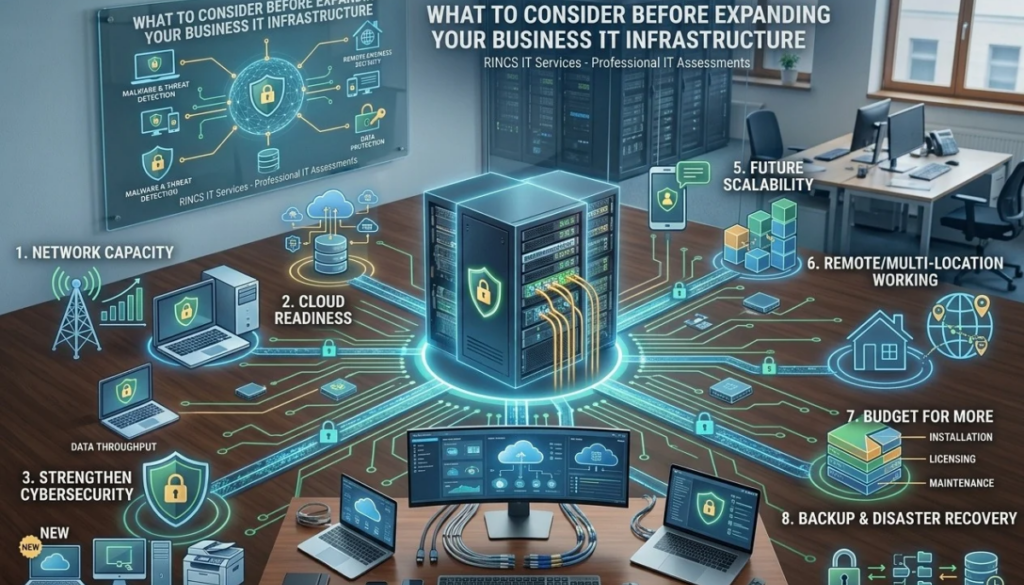
Expanding your business IT infrastructure is not simply about buying more computers or increasing internet speed. It requires a strategic approach that considers network capacity, cloud readiness, cybersecurity, hardware, data protection, and future scalability.
Planning ahead allows businesses to build a reliable technology environment that supports growth rather than becoming a barrier to it.
Need help preparing your IT infrastructure for business growth? A professional IT assessment can identify current weaknesses, future requirements, and practical upgrades to help your technology scale with your business.